 How-to
How to Handle Difficult Delivery Customers Professionally
Quick Summary
To handle difficult delivery customers professionally, stay calm, listen fully, and acknowledge their frustration before discussing facts. Verify the details together, offer one clear next step, and document the incident. If threatened or unsafe, set a short boundary, leave, and report it to a supervisor.
- Customers are often stressed before you arrive, so their anger usually targets the situation rather than you.
- Never argue a delivery fact on the doorstep; move to a solution first.
- Acknowledge the feeling, state a boundary, then offer an alternative.
- Photograph the package and drop location before touching the box, especially for damage claims.
- Write incident notes the same shift, quoting the customer's words where possible.
Table of Contents
- Why Difficult Delivery Customers Escalate So Fast
- Identifying Common Customer Types on the Route
- Phrases to Calm Angry Customers at the Door
- De-escalation Techniques for Customer Service on the Route
- Setting Boundaries Without Making Things Worse
- Dealing With Difficult Customers: Real Scenarios and Examples
- Documenting the Incident and Knowing When to Escalate
- Example of Dealing With a Difficult Customer: Interview Question and Answer
- Protecting Your Own Well-Being After a Tough Delivery
- Frequently Asked Questions
Why Difficult Delivery Customers Escalate So Fast
Customers are often stressed before you arrive, running late, expecting something important, or dealing with an unrelated problem.
A common mistake is treating every complaint as a personal attack. Most customers are angry at the situation, not at you, remembering that keeps your tone steady.
Watch out: never argue a delivery fact on the doorstep. Saying "the scanner says it was delivered" is almost guaranteed to inflame the conversation.
Identifying Common Customer Types on the Route
Not every difficult customer is difficult in the same way. Spotting the pattern early helps you choose the right response.
The Impatient Customer
This customer wants speed above all else. They check the app every few minutes and ask when you will arrive. Keep them updated with short, honest time estimates.
The Frustrated Customer
This customer had a bad experience earlier, with a late delivery or a damaged box. They may bring that history to your conversation. Acknowledge the past problem without taking blame for things you did not cause.
The Confused Customer
This customer does not understand where the package is, how to reach a locker, or what a delivery notice means. Slow down and explain one step at a time.
The Hostile Customer
This customer uses insults, threats, or aggressive body language. Your priority here is safety. Keep distance, stay calm, and leave if you feel unsafe.
Phrases to Calm Angry Customers at the Door
The words you choose set the tone. Use short, calm phrases that show you hear them.
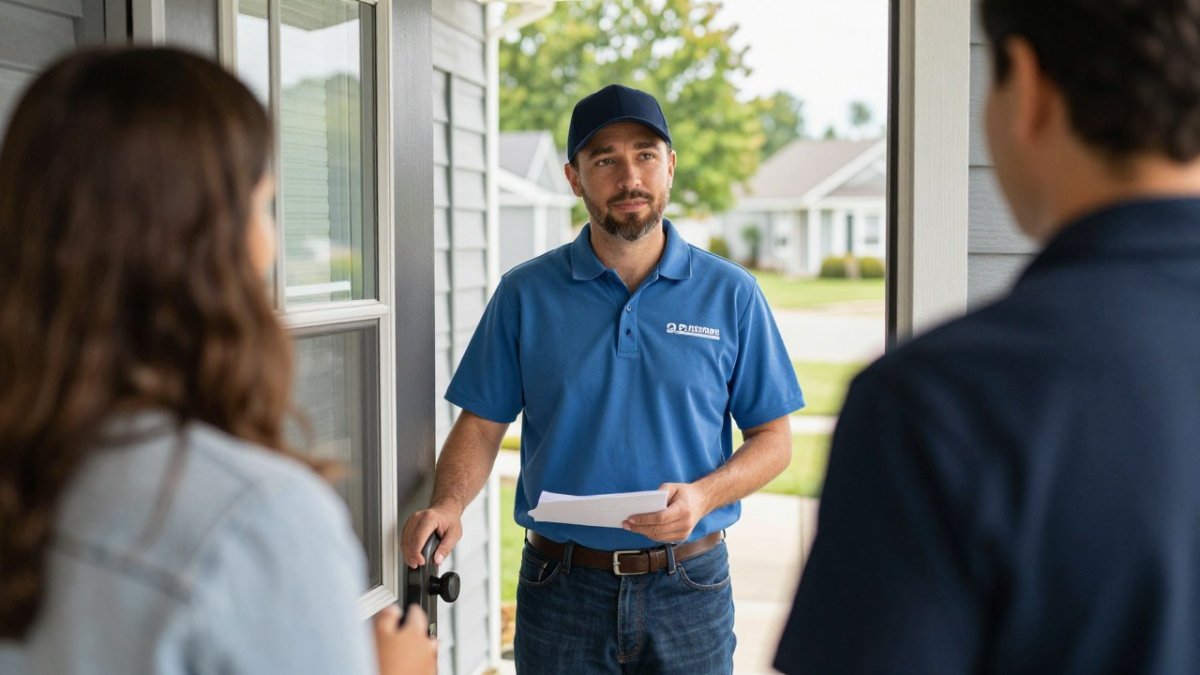
- "I understand why that's frustrating. Let me look into it."
- "Thanks for letting me know. Here's what I can do right now."
- "I can see you're upset. I want to get this fixed for you."
Avoid phrases like "calm down," "that's not my problem," or "there's nothing I can do." They sound dismissive and usually make anger worse.
De-escalation Techniques for Customer Service on the Route
De-escalation is a skill you can practice. The goal is to lower the temperature so the customer can hear your solution.
- Stay calm and composed. Keep your voice low and your pace slow. Your calm tone often sets the tone for theirs.
- Use active listening. Let the customer finish. Repeat the main point back: "So the package was left in the rain and it's soaked?"
- Show empathy and validation. Name the feeling, not the blame: "That sounds stressful, especially with the storm this week."
- Communicate clearly and transparently. Say what you know and what you don't. Never make promises you cannot keep.
- Offer one clear next step. Too many options overwhelm an upset person.
Watch out: if you feel your own heart rate rising, step back for a few seconds. A brief pause often reduces the tension more than any word you could say.
Setting Boundaries Without Making Things Worse
Boundaries protect you and make the situation fairer for everyone. Set them calmly, before the conflict grows.
A useful pattern is: acknowledge, state the boundary, offer an alternative.
"I understand you want this inside today. I can't carry packages inside the home, but I can leave it at the front door and send you a photo of where it is."
Other boundary examples:
- "I can't stay at the door longer than a minute. I'll wait for your reply on the app."
- "Please keep your voice calm so we can solve this together."
If a customer continues to shout, end the conversation politely and move on. You do not owe anyone your safety.
Dealing With Difficult Customers: Real Scenarios and Examples
Generic advice collapses when a customer is standing in front of you with a wet box. Below are the delivery conflicts that come up most often, each with the words to use, the evidence to check, and the point where the conversation stops being yours to solve. Treat the scripts as templates, tone matters more than wording, but structure keeps you from freezing.
Scenario 1: The late delivery
The customer has watched the app count down and the window has passed. Their first sentence is usually an accusation, not a question.
- Open with ownership of the wait, not the cause. "I'm sorry you've been waiting, I know that's frustrating when you've planned around a window." Do not lead with traffic, weather, or route volume; those sound like excuses until the customer feels heard.
- Give one honest updated time and one alternative. "I'm about fifteen minutes out. If that doesn't work, I can leave it at the front door with a photo, or hold it for a pickup point."
- Keep your estimate consistent with the app. If dispatch has pushed the ETA, say so plainly: "The app may still show the old time, the accurate window is now 3:15 to 3:30." Contradicting the app destroys trust faster than the delay itself.
Watch out: never promise a time you cannot control. A second missed promise turns a late-delivery complaint into a credibility complaint.
Scenario 2: The damaged package
This is the highest-emotion scenario because the customer may have lost something irreplaceable. Your job is to document, not to adjudicate fault at the door.
- Acknowledge the loss before the process. "I'd be upset too if that arrived like this. Let me get it documented properly right now."
- Photograph everything before touching the box further, the package as delivered, the damage close-up, the label, and the drop location. These photos are what the claims process will ask for.
- State what happens next in concrete terms. "I'm filing a damage report now. You'll get a claim reference, and the shipper will contact you about a replacement or refund." Avoid quoting refund amounts or timelines you do not control.
Scenario 3: The missing package
The customer insists nothing was delivered. Roughly half the time the package is on the property and they have not found it; the other half it genuinely went astray. Either way, the conversation follows the same order.
- Verify the facts together, out loud. "Let's check this together, the scan shows delivered at 2:14, and here's the photo of where I left it." Walking through evidence side by side feels collaborative; announcing it feels like a defense.
- Offer a physical search before a formal claim. Ask them to check behind planters, at side doors, with neighbors, and in the mailroom. Most delivery companies require a search step before opening a trace anyway.
- Open the trace or claim while they are still on the phone or at the door. "I'm starting a trace now, here's the reference number." A number in hand converts anger into a waiting customer.
Scenario 4: The access failure
The gate code is wrong, the buzzer does not work, the building needs a fob, or the customer is not answering the doorbell. The customer often blames you for not getting in.
- Explain the constraint, not the blame. "I can't get past the gate with the code on file, it's not opening. Can you buzz me in, or tell me a safe place to leave it?"
- Offer two concrete alternatives. A safe drop with a photo, a neighbor or front-desk handoff, or a reattempt the next day. Two options move faster than an open question.
- Log the access problem in the delivery notes before you leave the stop. The next driver should not repeat the same failed attempt.
Scenario 5: The hostile or threatening customer
This scenario overrides every script above. If a customer uses slurs, threats, or aggressive body language, the goal is exit, not resolution.
- Use one short boundary sentence, then leave. "I'm not going to continue this conversation while I'm being threatened. I'm leaving now and my supervisor will follow up."
- Do not turn your back immediately or escalate your voice. Move to your vehicle, keep distance, and call dispatch once you are safe.
- Report it the same shift. Threats are a safety incident, not a customer-service complaint, and they belong in a written report while details are fresh.
Across all five scenarios the pattern is the same: acknowledge the feeling, verify the facts together, offer one clear next step, and document before you drive away. Drivers who handle these well are not the ones with the best lines, they follow the same sequence every time, so the customer can predict what happens next.
Each scenario calls for a different first move, so the table below lists the core response for the five conflicts the article covers.
| Scenario | First move | Key step |
|---|---|---|
| Late delivery | Own the wait | Give one honest updated time |
| Damaged package | Acknowledge the loss | Photograph everything before touching the box |
| Missing package | Verify facts together | Open a trace while the customer is still there |
| Access failure | Explain the constraint | Offer two concrete alternatives |
| Hostile customer | Set one boundary | Leave and report the same shift |
Documenting the Incident and Knowing When to Escalate
Most guides stop at "write it down." That is useless without a standard for what a useful note contains, how fast it must be filed, and what happens afterward. A delivery incident note has three jobs: protect the driver, protect the company in a dispute, and feed the next route.
What a defensible incident note contains
Write the note the same shift, before details blur. A note written the next morning is worth a fraction of one written within the hour. Include:
- Date, time, and exact address or stop number. Use the same identifiers the dispatch system uses so the note can be matched to the delivery record.
- What the customer said, in quotation marks where possible. Paraphrase only when you cannot recall the words. Quotes carry far more weight in a dispute than summaries.
- What you did, step by step. "Offered a safe drop with photo; customer declined; offered reattempt tomorrow; customer accepted." Actions, not adjectives.
Keep the language factual. "Customer was angry" is an opinion; "Customer raised their voice and used profanity twice" is a record. Never include insults, speculation about the customer's mental state, or anything you would not want read aloud in a claims review.
Watch out: do not edit an incident note after filing to make it read better. If a correction is needed, add a dated addendum, silent edits undermine the note's credibility.
When to escalate, and to whom
Escalation is not a failure to handle the situation. It is the correct move when the problem sits outside your authority or your safety. Escalate to a dispatcher or supervisor when any of the following is true:
- Threats or intimidation. Any threat to you, a coworker, or another person goes to a supervisor immediately and, where warranted, to law enforcement.
- Property damage or suspected crime. A damaged package, a broken gate, a stolen item, or a customer accusing you of theft.
- A claim or refund decision. You can start a trace or a damage report, but you should not be the one approving money back.
Escalate in the moment for safety issues; escalate at end of shift for everything else. A supervisor who learns about a threat three days later cannot act on it.
Closing the loop: turning incidents into route improvements
This is where most delivery operations leave value on the table. A single difficult stop is an annoyance; the same complaint across ten stops is a process problem. Build a short weekly review, fifteen minutes is enough, where a supervisor reads the week's incident notes and asks three questions:
- Is this a people problem or a process problem? A rude customer is a people problem. Twelve "gate code wrong" notes in one building is a process problem, and the fix is a data update, not a script.
- What should change on the route? Access notes, drop-location preferences, delivery-window accuracy, or a flag on the customer account. Assign an owner and a date.
- What should change in training? If drivers are consistently escalating the same scenario, the script or the authority level is wrong.
Feed the answers back into the next shift briefing. Drivers who see their notes produce a real change, a fixed gate code, a corrected ETA, a customer flagged for a supervisor call, write better notes next time.
Finally, protect the record. Incident notes and photos should be retained according to your company's records policy and kept out of casual channels like group texts.
Example of Dealing With a Difficult Customer: Interview Question and Answer
Interviewers often ask how you handle conflict. A strong answer is specific and shows calm judgment.
Question: "Tell us about a time you dealt with a difficult customer."
Sample answer: "A customer was upset because a package was left at the wrong door.
Notice the structure: listen, verify, act, and close. Adapt the example to your own experience, and keep it honest.
Protecting Your Own Well-Being After a Tough Delivery
Hard conversations take a toll.
A common mistake is replaying the conflict for hours. Note what you learned, then let it go.
At 323 Logistics Solutions, LLC, we want drivers to feel supported after a tough day.
Best for: new drivers who want clear, practical steps before their first difficult doorstep conversation.
Skip if: you are already comfortable with conflict and only need advanced negotiation tactics.
Looking for a team that backs its drivers? Learn more about working with 323 Logistics Solutions, LLC in State College, PA, including paid training and clear paths to advancement. Apply now.
Frequently Asked Questions
How do you handle difficult delivery customers professionally?
Stay calm, listen fully before responding, acknowledge the customer's frustration without taking blame for things outside your control, and state clearly what you can do next. Keep your tone steady and your words short. If the customer keeps escalating, step back, keep a safe distance, and contact your dispatch or supervisor. Professional handling protects both the customer relationship and your own safety on the route.
What phrases can calm an angry delivery customer?
Useful phrases include "I understand why that's frustrating," "Let me look into this for you right now," and "Here's what I can do next." These statements validate the concern without arguing, and they shift the conversation toward a solution. Avoid phrases like "That's not my fault" or "Calm down," which tend to increase tension. Pair your words with a steady voice and open body language.
What should a delivery driver do if a customer becomes aggressive?
Prioritize your safety first. Keep distance, avoid physical contact, and do not follow the customer into a confrontation. State calmly that you will leave the package in a safe place or return to your vehicle. Then contact dispatch and document the time, location, and what was said. Do not continue the interaction if you feel threatened, and report the incident so your team can review it.
When should a delivery driver stop a conversation and contact a supervisor?
Contact a supervisor when a customer uses threats or abusive language, refuses to let you complete a delivery without reason, or makes demands outside your role. Also escalate if a situation involves a safety concern, a disputed delivery with significant value, or a customer who continues to escalate after you have tried de-escalation. Early escalation protects you and gives your team the chance to resolve the issue consistently.