 how-to
7 Tips for New Delivery Drivers to Succeed
Table of Contents
- Start With the Right Setup Before Your First Shift
- Delivery Driver Safety Best Practices for Every Route
- Delivery Driver Time Management Tips That Protect Your Rating
- Essential Gear for Delivery Drivers: What to Keep in the Van
- Tips for New Delivery Drivers on Managing Orders and Peak Hours
- Track Mileage, Expenses, and 1099 Taxes From Day One
- Avoid Burnout: Mental Health for New Delivery Drivers
- Conclusion
- Frequently Asked Questions
Last Updated: September 25, 2026
Start With the Right Setup Before Your First Shift
The best tips for new delivery drivers start before the engine turns over. Your first week sets your habits, and good habits protect your rating, your vehicle, and your paycheck.
At 323 Logistics Solutions, LLC, we train drivers in Amazon-branded vans across the State College, Pennsylvania region, so we see what separates drivers who last from those who quit in a month. The difference is rarely speed. It is preparation.
Here is what to sort out before your first shift:
- Download your delivery app and complete every profile step
- Set up direct deposit so pay lands on time
- Save your dispatcher's number in your phone
- Charge a backup phone battery pack the night before
- Walk your route area on a map before you drive it
Skip this and you will burn your first day on setup instead of earning.
Delivery Driver Safety Best Practices for Every Route
Safe driving is the one skill that protects everything else: your rating, your van, and your job. Follow these delivery driver safety best practices on every route.
- Buckle up before you move, every single stop
- Park so you never back into traffic
- Keep three seconds of following distance in town
- Scan crosswalks twice before pulling out
- Never rush a left turn across oncoming lanes
The Occupational Safety and Health Administration guidance on safe driving treats vehicle crashes as a leading cause of work-related death, which is why we build safety checks into every shift.
Most new drivers get hurt or cited for the same reason: they sprint between stops to save two minutes. That trade never pays off.
Night-Time Delivery Safety Protocols
Night routes need their own rules. Visibility drops, and so does your margin for error.
- Park under a streetlight whenever one is close
- Keep your phone in a mount, not your hand
- Text your dispatcher your location on remote stops
- Carry a bright flashlight and use it before you step out
- Trust your gut. If a stop feels wrong, call it in and move on
A common mistake is finishing a sketchy stop just to protect your numbers. No rating is worth your safety.
Delivery Driver Time Management Tips That Protect Your Rating
Time management is not about driving faster. It is about cutting dead time between stops, and that is where these delivery driver time management tips matter most.
Sort your load before you leave the station. Group packages by stop order so you never dig through the van at a doorstep. Then batch your actions: grab the package, scan it, and walk in one motion.
- Load in reverse stop order so the first drop is closest to the door
- Keep your scanner on your hip, not in a pocket
- Pre-write common drop-off instructions in your notes app
- Skip the elevator when stairs are faster and safe
- Check your next stop while you walk back, not while you sit
Small gaps add up. Ten saved seconds per stop across a full route is real time back in your day.
Using Navigation Apps and Heat Maps Effectively
Your navigation app is a tool, not a boss. Learn to read it, and you will beat drivers who follow it blindly.
Study traffic patterns before peak hours hit. If your app shows a jam building on the main road, leave earlier or reroute around it. Heat maps in your driver app show where demand clusters, which helps you plan a tighter delivery zone instead of crisscrossing town.
- Set your app to avoid left turns where possible
- Save apartment gate codes in your notes
- Watch for surge pricing zones during peak hours
- Recheck your route after every third stop
Essential Gear for Delivery Drivers: What to Keep in the Van
The right gear turns a hard shift into an easy one, and the wrong gear costs you ratings you cannot get back. Here is what belongs in your van every day, and why each item earns its space.
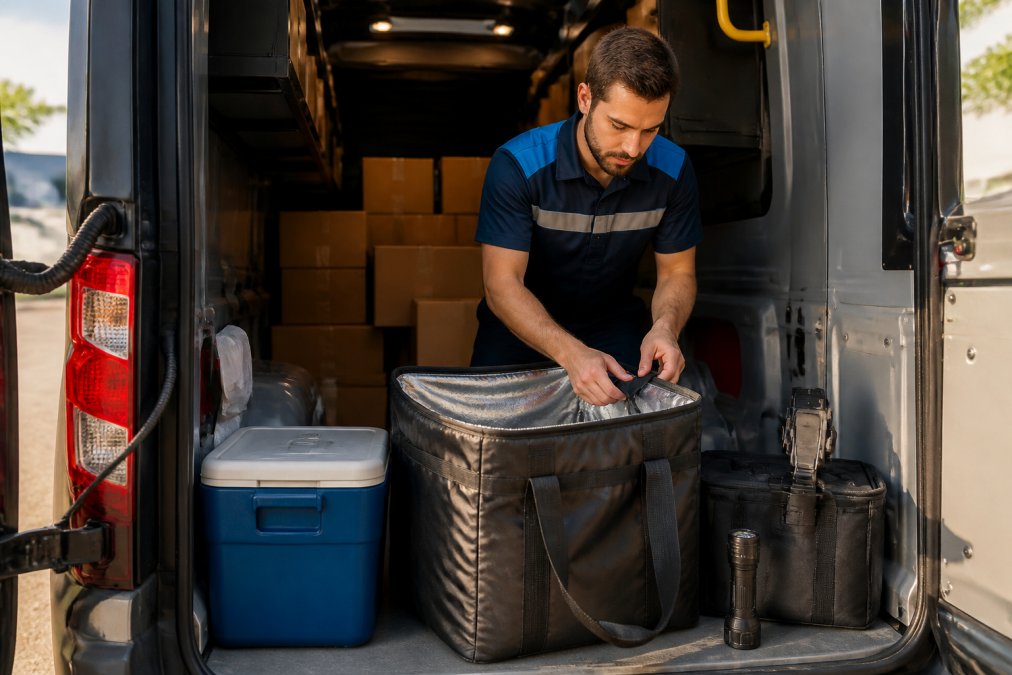
Thermal bags. A quality insulated hot bag is not optional on food routes. Heat loss is the number one reason a delivery gets rejected at the door, and a rejected delivery hits your customer rating directly. Look for a bag with a foil or reflective liner and a full zip closure, not a flap. One cold meal can cost you a full week of good scores.
A small cooler. Cold items and your own water both need a home. A soft-sided cooler keeps ice cream from melting on a long run and keeps you hydrated without stopping. Hydration matters more than most new drivers expect, dehydration mimics fatigue and slows your reaction time behind the wheel.
Phone mount and charging cable. A mount keeps your phone visible and your hands free, which is both a safety habit and, in most states, a legal requirement while driving. Carry a spare cable; a dead phone ends your shift early.
Flashlight and reflective vest. These are the two items that matter most after dark.
Pack the night before. Morning scrambling costs you time you cannot get back, and a van that is already stocked means your first stop is a delivery, not a supply run.
Tips for New Delivery Drivers on Managing Orders and Peak Hours
Order acceptance is a skill, and your acceptance rate follows you. These tips for new delivery drivers focus on the decisions that shape your week, not on hustling harder, but on deciding faster and smarter.
- What is the pay per mile, including the drive to pickup? Divide total pay by total miles, not just delivery miles.
- Where does it leave me? An offer that ends in a dead zone costs you the unpaid drive back.
- What is the time cost? A high-pay order with a 20-minute restaurant wait can pay less per hour than a modest order that is ready now.
Reading Peak Hours Instead of Just Surviving Them
Peak hours are not one block of time. They are a stack of overlapping windows, and each one behaves differently.
-
Lunch rush (roughly 11 a.m. to 1 p.m.): Short trips, dense clusters, fast turnover. Good for volume if you stay inside a tight zone.
-
Dinner rush (roughly 5 to 8 p.m.): Longer trips, higher payouts, but restaurant wait times climb sharply. Build buffer into every stop.
-
Late night (roughly 9 p.m. to close): Fewer drivers on the road, so demand per driver rises, but visibility and safety risks rise with it.
-
Accept orders that fit your zone and your route
-
Decline offers that pull you far outside your area
-
Track your acceptance rate so you know your standing
-
Build buffer time into peak hours for restaurant waits
-
Communicate with customers when a drop-off runs late
Track Mileage, Expenses, and 1099 Taxes From Day One
Delivery drivers are independent contractors, which means nobody withholds taxes for you. Start tracking on day one, not in April.
- Record your odometer at the start and end of each shift
- Photograph receipts the moment you get them
- Set aside a slice of each paycheck for taxes
- Keep a folder for your 1099 tax forms
- Review your mileage and expenses every month
Avoid Burnout: Mental Health for New Delivery Drivers
Burnout ends more delivery careers than bad routes do. Long hours, tight metrics, and time alone in the van wear people down.
- Take your full break, even on busy days
- Move your body between long drives
- Keep a friend or family member in your loop
- Ask your dispatcher for a lighter day when you need it
- Leave work at work when the shift ends
Conclusion
Delivery work rewards drivers who plan, drive safe, and track their money. Build the right habits in your first month and the job gets easier every week.
Frequently Asked Questions
What is the most common mistake new delivery drivers make?
The most common mistake is accepting every order without checking distance, pay, and drop-off details first. New delivery drivers who rush into low-paying, far-away orders burn fuel and time for little return. Review each offer, compare pay per mile, and decline orders that don't make financial sense. This single habit improves earnings optimization and reduces frustration during your first weeks.
How do I manage my time effectively during a delivery shift?
Plan your route before leaving the station, group stops by delivery zone, and avoid backtracking. Use navigation apps that support multi-stop routing, and keep drop-off instructions visible so you don't waste minutes searching. Build in buffer time for wait times at pickup locations. Delivery driver time management tips like these help you hit more stops per hour without speeding or cutting safety corners.
What safety gear should every delivery driver have?
At minimum, carry a high-visibility vest, a rechargeable flashlight or headlamp, and nonslip shoes. A phone mount keeps your hands free and your eyes on the road. In colder months, pack gloves and hand warmers. These items support delivery driver safety best practices and are especially important for night-time deliveries when visibility drops and parking areas are poorly lit.
What should I keep in my vehicle for a successful shift?
Pack a hot bag with thermal insulation for food orders, a small cooler for cold items, a phone charger, and a printed or digital mileage log. Keep water and a snack within reach so you aren't stopping mid-route. A basic first-aid kit and a tire pressure gauge are also worth the space. These essentials for delivery drivers prevent small problems from ending your shift early.